Thursday, July 14, 2022

Three Articles I Read Yesterday and How They are Connected

As often happens, I went down a rabbit hole the past day. Bari Weiss is a journalist who writes online and edits Common Sense which is part of Substack. She gave a speech at the new University of Austin which she then published. While it’s a plug for this new, non-conformist university, she writes about cancel culture and gives examples. She resigned from The NY Times a year ago or so for getting crosswise with younger colleagues and is a poster child for being cancelled not for being mean or lying or a crime but for disagreeing intellectually. The New Founders America Needs   What I get out of this is the extent of cancel culture present in elite academia and those who are products of the environment. Since I am not part of academia nor a product of an Ivy League school, I found it instructional. One thing I will say is that maybe the reason much of America rejects the Progressive and Democratic agenda is because of the assumptions that group makes that can result in cancel culture. A reasoning/values/tone that just don’t sit well with middle America. In fact, resulting in them saying, “What are they thinking?” and then ignoring their gobbledygook. 

Now onto the next thing. I follow Ms. Weiss on Twitter and she retweeted the announcement of an upcoming book release by William Deresiewicz, Googling him, I find he’s a former English teacher at Yale who became disenchanted with the way education is offered at that type of university. He left academia in 2008 to write full time. In 2014 he wrote a book, Excellent Sheep: The Miseducation of the American Elite and the Way to a Meaningful Life. So, now I understood why Bari Weiss follows him.  Oh, by the way, he lives in Portland, Oregon now. I read the following article from The Atlantic The Death of the Artist and the Birth of the Creative Entrepreneur  It is not a radical idea that he is proposing at all but is more a survey of the artist and how the role has changed in history.  It helped me make some sense of this profession in the 21st century. 

The last thing I read yesterday was the news that Apple and its long-time head of design, Jony Ive, were parting ways for good.  He and his team basically did all the design work at Apple since Steve Jobs came back to lead the company to dominance including the iMac, Power Mac, iPod, iPhone, iPad, MacBook and the Apple watch.  He left in 2019 to form his own design firm with Marc Newson but they kept doing work for Apple.  I didn’t know anything about Marc Newson but I learned that he’s a really big deal, too, and has designed all sorts of thins from chairs to airline cabins to bikes to appliances.  I found this online Interview with Jony Ive and Marc Newson where the two of them are talking about Newson’s workshop and their mutual love of tools and their concern that a lot of these skills will not be passed on to future generations.  This brought me back to the essay above which has the theme that artists are makers.  Obviously, Jony Ive and Marc Newson are makers and artists, as well.  And, pretty good ones at that.

Sunday, July 11, 2021

Network of Mutuality

We are caught in an inescapable network of mutuality, tied in a single garment of destiny. Whatever affects one directly, affects all indirectly.


Martin Luther King, Jr. from Letter from a Birmingham Jail,  4/16/63

Monday, July 5, 2021

Nobody's right if everybody's wrong


There's battle lines bing drawn and nobody's right if everybody's wrong.

Paranoia strikes deep.

Into your life it will creep.

It starts when you're always afraid.

Step out of line, the man come and takes you away.

     Stephen Stills  From What It's Worth


Cover by Billy Porter with Stephen Stills


Look out for each other. You don't have to be right.

Thursday, January 14, 2021

Bill Maher was Right: Trump was never going to go of his own accord


If you recall my post on this blog from Oct 13, I referred to Bill Maher's often repeated statements over the course of the Trump presidency that he would never leave voluntarily.  Bill was right.  The ongoing drama of the past 3 months since the election proves this true.  After the tragedy of last week's riot and deaths in the Capitol, the Constitution has worked though creaky and even Republicans congressmen and senators are starting to abandon him. His staff are vacating the west wing of the White House. No one tries to defend him not even his press secretary.  

What did we learn from this?

  • The people who work on actually administering elections at the local and state level do a great job. They are diligent, work very long tedious hours and persevere through harassment at a local level (examples in Detroit and Philadelphia) and even hold up at the state level as we saw in Georgia after the President pressured and threatened the governor and the secretary of state who are fellow Republicans.
  • The courts work. In lawsuit after lawsuit challenging the election results, the state and federal courts did their duty. It didn't matter if they were Republican judges or even judges appointed by Trump himself. They followed the process and the law.
  • The Congress did its duty as a whole. A majority of legislators followed the Constitution.  
  • Of course, we had some standouts who were craven opportunists, Cruz and Hawley stand out. But, they are just trying to appeal to the Trump base in hopes for running in 2024.
  • We learned that there are a large amount of people who supported Trump. They are populists and believers in conspiracy theories. They don't know history and our laws and government. They are aggrieved and believe in a demagogue. We learned they can be violent and when in a mob, lose their minds 
  • Trump is a failed man and a disaster as President. Now that Twitter has abandoned him, he is the bully who has been defanged and is fading from the public consciousness.

Conspiracies


I've thought about conspiracies a great deal. I know people from my hometown who were friends, graduated from college, and hold responsible positions in their communities. I cannot explain the belief in lies. I think that regarding conspiracies, many people including me have considered their possibility. I first became aware when I was a teenager and read the novel Captains and the Kings by Taylor Caldwell. In the novel an Irish immigrant builds a fortune and becomes part of a group of wealthy industrialists and financiers who control affairs of the country.  This particular story has the protagonist trying to make his son President of the US which was so similar to the story of the Kennedys and the plotting of Joseph Kennedy for his sons. Then there is the current television series the Blacklist on NBC featuring shadowy and powerful figures running the Cabal which controls the governments of the great powers. 

Perhaps it comes from the realization we all have at some point that we don't understand what is going on in the world and how things come about. I think we realize there are people who are probably smarter that we are, people who have more money, and people who have better connections.  All this is true.  Yes, people who know each other and who have resources do have opportunities most people don't have. Yes, we are aware of the power of cliques starting in junior high school. Yes, monopolists like to keep their secrets, pricing arrangements and control intact. When you are disadvantaged or even manipulated by the system, you resent that system and justifiably so. You look for explanations but some stories are just that, stories.

This is why we need to stop bullying in junior high school, offer opportunities to the disadvantaged, bring minorities into the mainstream, and go for diversity. We need to have antitrust laws and regulators. We need fair taxes and tax enforcement. We need to stop cheaters. Truly, everyone needs a fair shake. We need to trust the government and I think we can trust that the government ran fair elections based on my first two points at the beginning of this post. 

 I don't believe the Democratic party with all its divisions and inability to craft a good marketing message is capable of election fraud. Those yahoos cannot conspire to save their political lives; what makes anyone think they could pull off massive voter fraud in a voting system that is totally decentralized and not leave any evidence. No conspiracy, period.

Tuesday, December 15, 2020

Electoral College Reality


My sister Jean's birthday is December 14 which happens to be the same day the Electoral College's electors cast their votes for the President in 2020. FYI, I checked to see how many of her birthdays were concurrent with the Electoral College voting day and this is the third (1964, 1992 and 2020). The term I read is that the date of the Electoral College is usually a civics class afterthought. My sister never thought of December 14 as an afterthought I am sure. And, this year it certainly was not overlooked. In fact, it had some drama leading up to it with all the falsehoods about election fraud and spurious lawsuits. Thankfully, the judicial branch of government demonstrated some integrity and dismissed these fallacies of logic into the trash where they belong. Really, I think if a prospective law student wrote one of these briefs, they would never get an interview to law school. But, in the end the people who actually administer elections did their jobs and the the Electoral College had no drama whatsoever.

January 11, 1987  Cleveland Municipal Stadium

Perhaps things can start getting back to normal. And, the results of the Cleveland Browns football game last night make me think the universe is starting to get back in sync. You see, I am a Cleveland Browns fan and last night's last minute loss to Baltimore brought back that awful feeling I have had on similar Brown's losses, feelings of anger, betrayal, and then a deep despair that the world is not fair. The Browns have never been to a Super Bowl and they tend to lose heartbreaking games. For example, the 1986 AFC Championship loss to Denver culminated in "The Drive" was similar to last night's 4th quarter loss.  When you are a child you have fantasies of greatness realized vicariously through heroes. Of course, for most of us those visions do not get realized and we eventually become aware that such desperate hopes should not be wasted on a fantasy. So, last night made me painfully aware again of this lesson of adulthood. 

Similarly, the current occupant of the White house has had his childish fantasies squashed and he is having a difficult time. However, I doubt if he can ever let it go because he never has had the self-insight of why reality has not met his expectation. Undoubtedly, many of his diehard followers are feeling despair but hopefully most will move on and realize that their hero is just a failed man. They should quit hoping that their lives can be fixed by a man-child who has not realized his flaws or his fantasies. 


Sunday, November 8, 2020

Whew! How's the Water?

 I am grateful that the US Presidential election turned out the way it did.  Nina and I were seriously disturbed by the Trump administration; we've been quite stressed, not sleeping well, and having fantasies of revolution and violence.  I know we're not alone. I am relieved but wish the Biden victory would have been greater, more decisive, in order to show Trump and his minions how much they were disliked.  However, over 71 million people, 47.7% of the voters, chose him. For the past four years I've attributed the 2016 election result of people voting for Trump to a significant group that didn't like Hillary and didn't understand how unqualified Trump was to be President. I assumed that many of those 2016 voters would now see the light. Joe Biden is likable by about everyone; he fits the stereotypical model of the older white male with a qualified resume; and Trump was now a known entity.  I was wrong and I really don't know why I am wrong.  Me and over 75 million other voters don't understand the 71 million Trump supporters and I bet they don't understand me.

David Foster Wallace gave a commencement speech at Kenyon College in 2005 that turned into a small book called This is Water. I'd read it a number of years ago and it came to mind when pondering these two bubbles of American citizens who don't understand each other at all. He uses some cryptic stories that illustrate our problem. He offers some explanations about individual's templates and beliefs. He posits that some of a person's world view comes because we're hardwired but that people are also "arrogant and certain of their own interpretations... Blind certainty, a close-mindedness that amounts to an imprisonment so total that the prisoner doesn't even know he's locked up." You can find the speech on YouTube or the whole transcription at  This is Water

David Foster Wallace goes on to say that we have control over how we think about things. "It means being conscious and aware enough to choose what you pay attention to and to choose how you construct meaning from experience. Because if you cannot exercise this kind of choice in adult life, you will be totally hosed." I think many of the people in both groups of voters in this election are caught up in their own world views, hardwiring based on how and where you were raised and the experiences we've had.  And, indeed you should admit to yourself that arrogance is a factor in your choices of what you choose to think about and believe.  


Dave Chappelle was on SNL last night and had a great monologue with some hard truths and advice. We have to recognize that both groups have had terrible feelings of anguish. Chappelle suggests we have to, "Find a way to live your life. Find a way to forgive each other. Find a way to find joy in your existence in spite of that feeling."  

Amen

Tuesday, October 20, 2020

We Are All in This Together

Whether we want to be or not


All humanity is one community and we all have one global sickness. We are all contagious and always have been, unconsciously infecting one another and yet caring for one another. There is really no division. Sometimes we need to be cared for and other times we do the caring. We must learn to stand in these two different places and then change places as life happens.
 
There are no perfect answers or absolute heroes. We must all wear a mask to protect the other from "me". Don't play the victim; it's a waste of time, yours and everyone else's. Just realize you and everyone else are in the circle of life. We will all have our time to suffer, to serve and to hopefully be, albeit slowly, enlightened.


Paraphrased from the letter Richard Rohr sent today.

Tuesday, October 13, 2020

Presidential Election

 Rage by Bob Woodward


I recently read Bob Woodward’s new book on Trump called Rage. He covers four primary topics that have occurred in the current administration: the turnover of the Secretaries of Defense and State and the Director of National Intelligence, the investigation of Russian interference in the 2016 election, the relationship with North Korea, and the response to Covid-19. Woodward accomplishes this primarily by sharing direct conversations with either the parties involved or the President himself.  I believe his description of the conversations are accurate and fair. The quotations of the President in the book are similar to what I hear on radio and television. In addition, Woodward has not expressed undo bias in describing these four topics. I don’t believe Woodward is rooting against the President other than stating that because Trump is so fluid and volatile it is very difficult for people in his administration to stay in good graces; thus, these jobs are very difficult and stressful and turnover is inevitable. Regarding the Mueller investigation, he makes it clear that it was always under the control of political types such as Rod Rosenstein or William Barr but he provides no hint of allegation that there was collusion.

Lastly, we come to Covid-19.  Woodward gives Trump credit for shutting down international travel with China and the Europe based on the expert advice of scientists and his National Security team and for supporting the shut down of the economy. By the way, the National Security Director identified the coronavirus as the most significant security threat to the nation and to Trump's prospects for reelection at the end of December 2019.  Woodward by recounting the numerous conversations also illustrates that Trump was extremely conflicted about shutting down the economy because of its impact on reelection and how it makes him look. Woodward posed many hard questions to Trump about taking leadership on personal protective equipment and being a wartime president. Woodward coached Trump that if he was straight with the American public and took ownership and led, the public would back him and he would be reelected. But, that if he didn’t do those things and continued to deflect responsibility, he would lose in November.

State of the Election Today


So, here we are 21 days from the election. Biden is winning by significant margins in the polls. Even in the battleground states Biden has solid leads. If you’re a Biden supporter, things look good. Bill Maher the comedian who has a weekly HBO show that focuses on politics, despises Trump and believes with all his heart that Trump will not leave the White House even if defeated soundly.  He asks all his political guests, Bernie Sanders, Pete Buttigieg, Nancy Pelosi, etc .why they aren’t as worried as he is and what they are going to do about it.  All have stated that it’s a hypothetical and that they believe Trump is just bluffing in order to rile people up.  They all state that what we have to do is vote and turn out in huge numbers.  And, they are absolutely correct; first Biden has to win the vote and the more convincing the margin the harder it will be for Republicans to challenge the result. 

A Nefarious Scenario


However, last week Maher laid out what he believes Trump’s plan will be if he loses:
  1. In our Constitution we have the Electoral College as a way of electing the President and Vice-President. When we vote on Nov 3 we are really electing electors in our state who are pledged to vote for either Biden or Trump on December 14 this year. Constitutionally, whoever wins the popular vote in each state wins the pledge of all the designated electors in that state.  Some states have lots of electors (California has 55) and many have just a few electors (AK, DL, DC, MT, ND, SD, VT and WY each get 3).  It takes 270 electoral votes to win the Presidency.
  2. Here is the nefarious aspect of Bill Maher’s obsession.  What if the Republicans decide that they don’t trust the validity of the popular vote results in the battleground states such as Arizona, Florida, Michigan, Pennsylvania, North Carolina, Ohio and Wisconsin. Their reasons would likely be voter fraud particularly around mail-in ballots. The Republicans control both houses of the state legislatures in all these battleground states. What if these states cannot agree on whose electors get to vote, Biden's or Trump's? What if any contested states don’t send in their electoral votes at all?
  3. On January 6 a joint session of the US Congress meets and counts the electoral votes. If no candidate gets 270 electoral votes, the House of Representatives gets to decide. However, per our Constitution each state gets one vote only (California and Alaska are equal). The representatives in a given state decide upon a single candidate.  It takes 26 votes to win.  Republicans currently control 26 of the states in such a situation.  Two states are virtually tied, Michigan and Pennsylvania, so Democrats currently control only 22 states.  A new Congress is seated on January 1; thus, if more Democratic congressmen can be elected in Michigan and Pennsylvania and if two seats could flip in Florida, we would have a tie in  such a contingency. FYI, Nancy Pelosi realizes this and is fund raising to win more seats for her majority particularly in these close states.

Bottom Line

I don't think even Trump thought he would win in 2016. He creates such chaos that very strange things happen and I believe he could turn things around and still win the electoral college. If Trump loses the popular and the Electoral College elections as current polls project, I do not put it past him to follow the Bill Maher scenario which would start a very dark period in this country. I fear that rioting and rebellion on a large scale would occur.  So vote for a president and vote in your House and Senate elections, as well. Let us just make this a legitimate election and hope that both parties do their duty to support the will of the people. 


Sunday, September 13, 2020

Air Quality in Portland is the Worst in the World


The West Coast is burning. Many have had their houses burned, their autos are skeletons and thousands are now refugees from the wild fires.  The West is too dry and the underbrush has not been thinned. By late August and September the forests are tinder and a spark and winds bring conflagration.  The smoke hangs over the states of Oregon, Washington and California. The smell permeates everything and can sting your eyes and make your throat sore even insides. Our dogs do not even want to go out for a walk.  I am sure asthma and lung disease will devastate many.

Climate change is real and now we are seeing the results both economically and personally.  Wait until the seas rise and all the dams and dikes cannot protect our low lying cities. Florida will be underwater as will the Eastern seaboard and the Gulf coast. You can deny science for so long to support your lifestyle but fires, air quality, water levels and our lungs do not care. They will react as the laws of physics, chemistry and biology dictate.  I suggest you vote as if your life depends upon it. Yes, dealing with climate change will be very expensive and disruptive but as Bernie Sanders said, "Expensive as opposed to what?"

Sunday, August 23, 2020

The Jersey Shore of My Imagination

Where the Bruce is loud and the Rolling Rocks are cold

Jennifer Finney Boylan is a Philly girl who's family went to the Jersey Shore in the summers. She is now an author, transgender activist and English professor at Barnard College. She wrote this wonderfully evocative piece in the New York Times on Thursday August 20, 2020. I didn't grow up going to the Shore; I grew up in Ohio and we'd to Lake Erie which isn't a scene like the Atlantic coast. Not until my brother married into a Philadelphia family who went to the Jersey Shore, did I understand how wonderful and what an escape it is. My family started to join Tom and Leslie on Shore vacations. We rode out Hurricane Bob in 1991 at Cape May. My son loved the beach just like Jennifer Finney Boylan's friend Mickey said, "You know, this beach is a good idea." Families change where they vacation. Tom and Leslie tend to go to the Outer Banks and reside part time in the Poconos. My son Drew and his wife Sarah go to Virginia Beach. But this article will bring back those sights, sounds and smells which directly link to the memories of summers past.

Tuesday, August 18, 2020

Richard Rohr at Chautauqua

 Last year I went to Chautauqua in upstate New York for the first time. Chautauqua is famous for providing education over 9 weeks every summer on various topics of secular, religious and cultural basis. It is an institute started in the late 19th century that has evolved and is now ecumenical and multi-cultural.  Originally it was a place for families to come in the summer by train, relax on beautiful Lake Chautauqua and be entertained by sermons, lectures, music, dance and theater.  Over time families built houses and the institute expanded its facilities and a grand hotel was built.  Now you can stay on the grounds in the hotel or rent a house or stay off the grounds and drive in for the day's events.  Of course, this year everything is changed with Covid-19.  All programs are presented virtually and can be seen over the web.  Here are the themes for this year's program.  Check out their website and see the diversity of speakers and presentations. 

Week One • June 27–July 4 | Climate Change: Prioritizing Our Global and Local Response

Week Two • July 4–11 | Forces Unseen: What Shapes Our Daily Lives

Week Three • July 11–18 | Art and Democracy

Week Four • July 18–25 | The Ethics of Tech: Scientific, Corporate and Personal Responsibility

Week Five • July 25–August 1 | The Women’s Vote Centennial and Beyond

Week Six • August 1–8 | Rebuilding Public Education

Week Seven • August 8–15 | The Science of Us

Week Eight • August 15–22 | Reframing the Constitution

Week Nine • August 22–30 | The Future We Want, The World We Need: Collective Action for Tomorrow’s Challenges

This week, week eight, is on the topic of Reframing the Constitution. with scholars such as Jeffrey Rosen and Robert Levy and historian Jon Meacham. The big artistic name is violinist Joshua Bell. Giving a series of lectures in their Interfaith Lecture Series is Father Richard Rohr. Richard is famous as a speaker and author; he is a Franciscan priest and heads the Center for Action and Contemplationin Albuquerque. I know Richard personally from Cincinnati when we were both young men and he was co-head of the New Jerusalem Community and I was a recent ex-Jesuit looking for a community and parish. I believe I can say that Richard is the best preacher I have ever heard and what he says makes sense to you in your deepest source because he speaks honestly and unvarnished.


This year he is speaking on the subject of evil and is attempting to explain it. He does not mince words though the subject is difficult to define. You won't be overwhelmed with piety nor does he give a Roman Catholic only perspective. I think you'll find a touchstone whatever your faith perspective may be. Enrolling in all the Chautauqua program for 2020 is a bargain of $45 for the entire season and all the lectures and artistic performances are included. And, the first 90 days is free. If its not your cup of tea, cancel your membership. But give it a try and consider taking in Richard's lectures.

Wednesday, July 22, 2020

View of the Protest from a Higher Point of View


View from a friend's apartment within the four block perimeter of the 
downtown Portland Federal Building

Tuesday, July 21, 2020

Portland, Land of Protests


What to say about Portland? It’s beautiful here; the weather has been perfect for the past week with blue skies, temperature in the 80’s during the day and 60’s at night. Low humidity and you can see the mountains. The town is full of creative types doing innovative interesting things. It's liberal. You can be gay here and no one looks twice. It will definitely vote for the Democrats and Trump is despised. However, it has a long racist past. There aren’t many black people; Portland is the whitest big city in America. One of the former African American neighborhoods was destroyed by the interstate highway running though downtown as well as the Moda Center basketball arena and the Convention Center. Blacks were forbidden from buying property in white areas of the city. 


Like many cities, black men are still being shot and killed here by our police without ramifications.  The police were under a federal court order to reform. They’ve brought in an African American woman to be the chief of police who's since moved on to Philadelphia. The culture of the police department is still one of command and control and you better not be around if you’re a person of color or you could still end up dead.  So we now have Black Lives Matter protests going on for over 50 days.  It's an odd conglomeration of groups that gather to protest. Of course, some are from BLM but there are others that join in to protest other things (fascists, environment, homeless, jobs, gender/transgender).  And, of course, there is a criminal element that started a small fire at the courthouse and have written graffiti downtown particularly on the Federal Building. From what I can figure, this 2 minute video maybe best describes what the protestors want which is for massive changes.


However, after about 50 days the protestors were down to around one or two hundred and the movement was on the wane. In truth, as long as you avoid the 4 blocks around the Federal Building during the protest at night, there has been no disruption to our town. The city police and the protestors had reached an agreement that as long as there wasn’t violence, the people could protest, maybe tag a few buildings, maybe throw some fireworks and the police wouldn’t shoot, arrest anyone or use tear gas. Most Portlanders not involved in the protest had a “whatever” kind of attitude about the whole thing and assumed that just like the 99% protests of several years ago, protests would eventually dwindle to a few people holding signs in the park.


Last week Trump sent Homeland Security paramilitary people to Portland. The Acting Secretary of Homeland Security came to town and gave a get-tough speech.  They certainly weren’t invited by the mayor or the governor.  Some reputable reporting was done by OPB, the public radio and television affiliate in Oregon, about some people being apprehended on the street and taken away in unmarked vehicles by Feds. We’ll see what the US Attorney and Oregon Attorney General find out. I’m sure there will be congressional investigations at some point.  I believe Trump is just using these amateur quasi-military types to stir up his base. He has nothing to lose in Oregon since this state and the whole west coast is going to go for Biden. But now, with the Federal agents invading our city, abducting citizens like you’d see in a dictatorship, shooting projectiles and injuring people, and deploying tear gas, the protests have swollen. 

Navy Vet being beaten and tear gassed by Feds
One of our local papers, The Oregonian, gave a description of Portland during the BLM protests. And, truly, as long as you stay out of the protest area , there isn’t any change to our city. The keystone cops have gotten physical as demonstrated with this video of them whaling on a Navy veteran and graduate of Annapolis who came down for the first time over the weekend to see what was going on.  I love this video of a naked woman in a mask who struts in front of the advancing Feds and stops them in their tracks; the Feds didn’t know what to do and withdrew.  The crowds are in the thousands now; we even have Moms (#MAFIA Moms Against Fascism in America) in yellow shirts linking arms, singing and taunting the Feds and police. Last night they had a chant going using Ice Cube’s refrain to Fuck the Police from the Straight Outa Compton album.  It’s quite a scene.  The protests are not going away and I would guess that eventually the Feds will go home. 


After they go home, I don’t know what will happen to the protests. We have an election in November and there won’t be any question about the results in Oregon for any of the federal offices. However, our mayor, Ted Wheeler, is up for reelection. He would have won easily because he’s done a nice job on the Covid19 response and was doing okay with BLM until the Feds showed up. There was progress on defunding portions of the Portland Police department’s responsibilities. But, the police department was allowing the Feds to participate in their planning meetings and the police were getting physical over the weekend when the protests gained momentum again. He’s making statements objecting to the Feds but I don’t see activity in addressing the protestors' requirements.  He appears to be dithering. Unless he takes leadership and really gets the Feds out, makes progress on reengineering the police department, addresses the needs of the black community, and deals with our huge homeless situation, he’s going to lose the November election.

Monday, June 29, 2020

I'm curating and hope its useful.

I'm going to post summaries of articles that I have read recently so that you may decide if you want to read as well.  Let's talk about the President first then some good news and then some predicting the future.


I think most damning is by Peggy Noonan in the Wall Street Journal. In her words, "He hasn't been equal to the crises. He never makes anything better. And everyone kind of knows."   The Week It Went South for Trump.

Next is by Maureen Dowd of the New York Times:   Republicans have a history of playing on the fears of white people by labeling people with dark skin as invaders:  Trump: Not So Statuesque  Things are looking down for the Donald.
  • Nixon's Southern strategy.
  • Willy Horton ads by George HW Bush.
  • W and Cheney playing on the fear of Al-Queda terrorists.
  • Trumps reaction to Black Lives Matter protesters as agitators and anarchists; defending Confederate statues; promising a wall to protect us from Mexican criminals, drug dealers and rapists; recent immigration policy changes banning visas.

And, on that note, let's turn to Nicholas Kristof today for an uplifting piece of good news: 
  • He describes the Hispanic paradox of how poverty and discrimination do not lower the life expectancy of Hispanics. They have a life expectancy of 81.8 years vs 78.5 years for whites and 74.9 years for blacks. 
  • He describes a strong social fabric and how Hispanics take care of those within their communities.   

I thought Ross Douthat was insightful in that he posits that the viral pandemic will cause an acceleration of changes already in progress in the US. So much so that by the time we exit the pandemic in 2022, the country will take on changes that without the pandemic would not have evolved until 2030.  
Waking Up in 2030 The suspended time of the pandemic has put history on fast-forward.
  • There will be an acceleration of the demise of midsize daily newspapers and the national news media will have even more advantages.
  • Higher education will evolve further with online education. in addition, foreign enrollment will decline and the marginal state universities and many small liberal arts colleges will financially collapse.
  • Church attendance will decay faster and many small churches will go away. In addition, parochial schools and parishes will consolidate even faster.
  • The political shift to the Democrats is being accelerated by the Trump administration disaster and more states will shift from Red to Blue maybe even for the current election.


Sunday, September 21, 2014

We went to see Herbie Hancock this evening.  It was amazing.  I'm blown away by the deconstruction and then integration that his quartet performed.  Even at its most basic it was recognizable.  Even at its most integrated, which they took things to layers and levels beyond where a piece of music may have ever been before, its still recognizable.  Beautiful and awesome.  Ageless Herbie and accompanied by Lionel Loueke who may be the the best guitarist I've seen.  James Genus on bass and Vinnie Colaiuta on drums. 

Wednesday, June 12, 2013

Information Just Wants to Be Free


In my prior two postings I postulated that information wants to be free and cannot be contained.  That term is anthropomorphic isn’t it?  Information isn’t a being that can be attributed with human emotions or desires such as freedom.  However, the fact remains that it doesn’t appear that it can be contained. 
Genetic information is going to express itself in the environment.  We cannot keep it restricted to certain farmers who have licensed seeds to obtain particular properties such as crop yield or particular nutritional values.  Those plants when they reproduce will spread their pollen and seed and that which was legally constrained will travel via breeze, stream or animal carriers to places unforeseen. 
The information stored on computers also has a way of getting out.  Either you share it and give up the rights to your privacy for some presumed benefit.  Or, it gets stolen via a mistake by the steward of the data.  Or, the law is used to exert the right of eminent domain.  It gets out.
Last week the US government’s efforts to secretly monitor telephone metadata and social network information was exposed by the Guardian and the Washington Post.  So, not only do these disclosures  indicate that government will get to your data.  But, it indicates that government’s own secret information cannot be contained and kept classified either. 
My grandfather once said, “Don’t do anything you wouldn’t want on the front page of the Shelby Daily Globe.”  His advice was to an eight year old was made in a world before ubiquitous computing and communication.  It was made in the context of a small Ohio town over fifty years ago that left doors unlocked and keys in the ignition.  People were going to know your business so you you’d better be responsible or pay the consequences. 
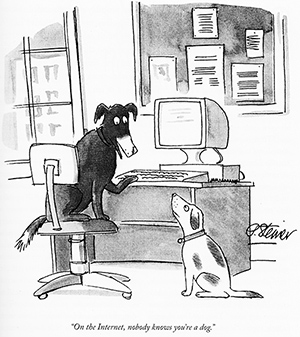
I think the statement is as true now then as it was then and it applies to both individuals and governments.  Too many people have a fantasy that they can make up online identities and interact with the outside internet.  They think they can hide behind a digital anonymity or the state’s secrecy laws and million-person security apparatus.  But, it just is not so.  You can’t hide information; you may delay its exposure but eventually information will be disclosed and used.


Peter Steiner's cartoon, as published in The New Yorker

Monday, June 10, 2013

Big Data: Government Surveillance


The big news at the end of this last week was that the US government has been collecting internet and telephone data in order to combat terrorism.  Is anyone really surprised? 
I have been involved in what can be done with big data since 1987.  I never worked with government but only commercial businesses that had large amounts of data in industries that were undergoing tremendous change.  Our biggest customers were telephone companies, large retailers, airlines, and banks.  As you may recall, the 1980’s began a period of deregulation.  AT&T agreed to be broken up into separate units in order to foster competition.   The Airline Deregulation Act of 1978 took the federal government out of setting fares and determining routes.  The financial sector saw the consolidation of banking and insurance and the repeal of Glass-Steagall.  The change in retail can be attributed to one firm: Wal-Mart dominated its category and influenced all of the industry with a big-box format, sourcing from low-cost manufacturers across the world, every day low prices and aggressive expansion.
What did all the firms in these industries do with all this data?  Typically they figured out who their customers were.  Prior to these changes either they didn’t care because they were operating in a monopoly environment and didn’t need to cater to customers.  Or, they operated at a small enough scope that the managers of the stores knew who their customers were from personal interaction.  However, once deregulation and consolidation occurred they couldn’t rely on personal knowledge; these businesses had to rely on data. 
The volume of data and the speed with which they processed it kept increasing.  They modified the capturing of the data at the customer touchpoint so that it could be collected in more detail.  They also introduced loyalty cards to induce customers to continue shopping or flying with them; but, more importantly, the loyalty cards allowed them to know when a customer came back and what they were buying; and, they got contact information for these individuals.
In other words, they could identify their customers; they knew where they lived, what their demographic are, who lived with whom.  Companies knew what they bought and when they bought it.  With telephone customers, they knew who was calling whom, how long they communicated, how often, and at what time of day these communications occurred.  The financial institutions knew your assets and how you spent your money.  The transportation firms knew where you traveled, when, and how long you stayed.
Then in the 1990’s the mobile phone became ubiquitous and the internet became consumer oriented with the changes derived from telecommunications deregulation.  We could communicate anywhere with the phone, web, email, text and tweet.  We could find out about anything from anywhere.  We could buy anything from anywhere.  The amount of data exploded and the amount of change to our lives was massive.  As Thomas Friedman stated so well in The World is Flat, the world became globalized.
The second thing these firms evolved to doing with all this data was predicting and then influencing what a customer was going to do.  They know what products and services you will likely buy.  They know when you’ll make this transaction. They predict how much bandwidth, airplane seats, teller machines, etc. will be needed.  Retailers know how much inventory they will likely need for a product that has never been sold.  On Black Friday they know within a few hours of stores opening on the East coast whether their predictions about retail customer behavior is accurate or not and then modify pricing before Denver stores even open.  They can instantaneously customize the webpage and the products offered to you based on what they know about you and your past behavior. Online advertisements are presented instantly to you because of where you’ve browsed in the past, who you’ve friended, and what you’ve liked.
Which leads me to my first question to you.  We have given very personal information about ourselves to the businesses we choose to interact with.  They know us intimately and seem to adapt to our whims instantaneously.  Now, place yourself in the federal government as someone responsible for defending us against terrorism.  Since the Oklahoma City bombing almost two decades ago, we have had a torrent of people who want to fly airplanes into iconic buildings, bomb public events and disable our digital economy.  Would you not want to use this information available about individuals to determine their nefarious whims?  Why should you be surprised that it has occurred?
When this kind of information is available and used openly in the commercial sector for twenty-six years, I can only assume that a government would use it, as well.  I admit I don’t like the thought of it with my libertarian ideal of privacy.  However, I like my frequent flyer miles and the discounts from using my loyalty card at supermarkets; I sell stuff on Craig’s List and I buy from Amazon; I use LinkedIn to market myself.  I use these things because I perceive them to be in my interest.  But, if I knowingly relinquish my privacy to an internet search engine, I am relinquishing this information to government, too. 
In some ways, its similar to the argument I made in my post on GMOs; in that case, if genetic material is made available to the environment, it will spread and you cannot predict how or where.  Genetic material is a code; it is information.  Likewise, any digital information, once disclosed on the internet, is going to spread; you cannot predict how its going to be used nor where it will be used.  Maybe it’s a law of nature that information, genetic or digital, cannot be contained.

Thursday, June 6, 2013

Genetically Modified Organisms


The issue of genetically modified organisms (GMO) such as wheat or corn gets a lot of press.  For instance, this article from today's NY Times is about a farmer in Oregon who has found wheat in his field that has the gene inserted by Monsanto that will allow the herbicide Roundup to be used on it without killing it while getting rid of weeds.  The farmer's issue is that he has never purchased the wheat seed from Monsanto that has the genetic modification; nonetheless, its now present in his fields.  Out here on the West Coast this issue gets a lot of attention.  However, too many people protest the genetic alteration of plants for the wrong reason.

Too many think that the plants with altered genes will cause them some sort of harm.  I suppose they think that the genetic material will somehow alter their own genes.  It will not and let me explain.  When your body ingests food, it will break that food down to into very basic materials.  They'll be reduced in your stomach and bowels into carbohydrates, fats, proteins, and nucleic acids which are the building blocks used to make up cells.  The genetic material only exists at the cellular level.  After digestion there is no cell left and the genetic code which is in DNA and RNA are broken down to the pieces of the genetic alphabet, the nucleotides of adenine, thiamine, cytosine, guanine and uracil.  A gene only has meaning when the letters of the alphabet are in a very particular order. 

After digestion you cannot possibly determine from what type of cell and from what type of organism the nucleotides originated let alone what gene.  Genetic material cannot pass from one species to another via ingestion.  So, anyone who says that genetically modified foods could harm them by modifying their own genetic material is full of hogwash. 

Now what you can be offended about is the whole issue of using herbicides.  Any residue of herbicide on the plant being protected may cause harm.  And, even if the residue isn't present by the time you ingest it, the runoff of the herbicide into the soil and ground water may cause problems for other plants, animals or humans in the food chain that may be poisoned. 

In addition, you may be offended by the idea of making genetic modifications to any organism because of the problem of unintended consequences.  As illustrated in this story, once you let an organism out into the world you don't know where its going to end up  with a case in point being this Oregon farmer's wheat crop.  You also don't understand what impact it will have on the ecology.  We certainly have all sorts of examples of noxious plants such as some species of honeysuckle, scotch broom, and kudzu which have become dominant and crowd out other species of desirable plants. 

The other problem with genetically modifying plant either by engineering or by selective breeding is when it becomes the dominant variant and diversity is lost.  Take for example, the Irish Lumper potato in 19th century Ireland which became the staple of the population's diet until Phytophthora infestans came along and wiped out the crop resulting in the Great Famine.  If we become dependent upon the dominant variant, when pestilence of some sort occurs, as it always seems to do, we are at risk.  Diversity is good.

We may not want genetically modified food due to its impact on diversity.  We may not want to aid and abet the use of herbicides.  We many not want unintended consequences.  However, we do not need to fear our own genetic modification. 

Tuesday, June 4, 2013

A New Bishop of Oakland

A new bishop was ordained in Oakland last week, Michael Barber, SJ.  It was conducted at the beautiful Cathedral of Christ the Light.  I lived in Oakland for two years while going to school there.  I liked Oakland; it is vibrant, quirky, has cool architecture and a diverse population.  Medical people like to practice there because of the international population and the challenges of the diseases that they bring.  Berkeley with its culture is close by.  Jerry Brown, who is now the governor of California, had been mayor and is responsible for much of its revival.  He is present at the ordination and gets a shout out as a former Jesuit.

This video is the new bishop's homily.  I like his style and humor.  Barber is a native Californian and makes references accordingly.   Of course, I'm predisposed to liking Jesuits.  Why is that other than having spent a year in the Jesuits myself?  You have to go to the founder of the Society of Jesus (Jesuit is a derivative name), Ignatius of Loyola (1491-1556) who is the creator of the Spirtual Exercises.  The Exercises are a method of going back to the foundation principles of faith in Jesus and how he guides us in following him.  Its brilliant in that it makes use of not only scripture and tradition but psychology to help the person following the exercises to examine their motivations and behavior.  You learn how to find out what is really going on within and for making decisions that are fully integrated into your personhood.  The Exercises become a way of doing things for the rest of your life and not just for the 30 day retreat where they are initially made.

A Jesuit is trained to examine themselves every day and touch base with the basics of what they are doing and the decisions they make.  At their best, I think this is what can make Jesuits so effective.  They know what they are about and what they going to do; they are directed.

Monday, June 3, 2013

Slippery Slope

We all have adverse periods that come from time to time.  Perhaps it is the stress of school or of trying to find a job in a tough job market.  Maybe it is sickness or the death of someone close.  It could be due to a realization of diminished skills in a competitive market or, even worse, diminished capacity due to failure of mind or body. 
One of the things that I’m experiencing at the present time is some adversity.  It has been many years without a period of troubles for me. Two types of things I have observed about myself. 
First, I get angry and feel that the situation is not fair.  I can make a cogent argument about particular individuals’ rudeness, the inequities in the job market, etc.  I then can get vengeful and even make plans of how to get back at people, organizations, or the system.  But, then I think about the suicide bombers. Like a lot of Americans, I wonder how can they think such actions can help their cause.  However, when I become bitter and feeling sorry for myself, I can see how frustrated young men who have no chance for getting a job and following their dreams could strike back in the horrible ways we’ve been seeing in the Middle East and even Boston.  When anger, frustration and impotence takes over, rational behavior dissipates. It is a slippery slope.
The second thing that these feelings trigger are memories of prior incidents from my past.  I remember not being able to find a job in Cincinnati in 1976 and sleeping on my sister’s couch for months while typing cover letters to go out with resumes.  I remember getting stiffed for a rent deposit by a landlord.  I remember adding up the bills that my wife and I had as a young couple with a new baby and realizing that there was not enough income to meet our very frugal expenses.   I also recall with chagrin that I didn’t always respond appropriately and had regrets for a letter written or a conversation conducted.  The Newtonian law about every action having an equal and opposite reaction is true in personal behavior as it is in physics.  My responses of blowing off steam may or may not have had any direct result but there was regret on my part. And, I don’t know what may have been the long term effect on those caught in the shock waves of my actions. 
With this reflection I can only try to better manage myself in the current situation.  I realize that I need to recognize the anger but I should not respond to immediate wounds.  I can only work to improve my situation by changing my approach and to not give in to despair.  I can also remember those who have situations much worse than my own.  The Palestinian men, the civilians caught in the wars in Syria or Congo, the minorities that are discriminated against, the inequity of pay for women, or those who are chattel in their cultures.  Not only does such reflection give me better perspective now but I need to keep these things in mind when my relatively miniscule issues are resolved.