Tuesday, August 18, 2020

Richard Rohr at Chautauqua

 Last year I went to Chautauqua in upstate New York for the first time. Chautauqua is famous for providing education over 9 weeks every summer on various topics of secular, religious and cultural basis. It is an institute started in the late 19th century that has evolved and is now ecumenical and multi-cultural.  Originally it was a place for families to come in the summer by train, relax on beautiful Lake Chautauqua and be entertained by sermons, lectures, music, dance and theater.  Over time families built houses and the institute expanded its facilities and a grand hotel was built.  Now you can stay on the grounds in the hotel or rent a house or stay off the grounds and drive in for the day's events.  Of course, this year everything is changed with Covid-19.  All programs are presented virtually and can be seen over the web.  Here are the themes for this year's program.  Check out their website and see the diversity of speakers and presentations. 

Week One • June 27–July 4 | Climate Change: Prioritizing Our Global and Local Response

Week Two • July 4–11 | Forces Unseen: What Shapes Our Daily Lives

Week Three • July 11–18 | Art and Democracy

Week Four • July 18–25 | The Ethics of Tech: Scientific, Corporate and Personal Responsibility

Week Five • July 25–August 1 | The Women’s Vote Centennial and Beyond

Week Six • August 1–8 | Rebuilding Public Education

Week Seven • August 8–15 | The Science of Us

Week Eight • August 15–22 | Reframing the Constitution

Week Nine • August 22–30 | The Future We Want, The World We Need: Collective Action for Tomorrow’s Challenges

This week, week eight, is on the topic of Reframing the Constitution. with scholars such as Jeffrey Rosen and Robert Levy and historian Jon Meacham. The big artistic name is violinist Joshua Bell. Giving a series of lectures in their Interfaith Lecture Series is Father Richard Rohr. Richard is famous as a speaker and author; he is a Franciscan priest and heads the Center for Action and Contemplationin Albuquerque. I know Richard personally from Cincinnati when we were both young men and he was co-head of the New Jerusalem Community and I was a recent ex-Jesuit looking for a community and parish. I believe I can say that Richard is the best preacher I have ever heard and what he says makes sense to you in your deepest source because he speaks honestly and unvarnished.


This year he is speaking on the subject of evil and is attempting to explain it. He does not mince words though the subject is difficult to define. You won't be overwhelmed with piety nor does he give a Roman Catholic only perspective. I think you'll find a touchstone whatever your faith perspective may be. Enrolling in all the Chautauqua program for 2020 is a bargain of $45 for the entire season and all the lectures and artistic performances are included. And, the first 90 days is free. If its not your cup of tea, cancel your membership. But give it a try and consider taking in Richard's lectures.

Wednesday, July 22, 2020

View of the Protest from a Higher Point of View


View from a friend's apartment within the four block perimeter of the 
downtown Portland Federal Building

Tuesday, July 21, 2020

Portland, Land of Protests


What to say about Portland? It’s beautiful here; the weather has been perfect for the past week with blue skies, temperature in the 80’s during the day and 60’s at night. Low humidity and you can see the mountains. The town is full of creative types doing innovative interesting things. It's liberal. You can be gay here and no one looks twice. It will definitely vote for the Democrats and Trump is despised. However, it has a long racist past. There aren’t many black people; Portland is the whitest big city in America. One of the former African American neighborhoods was destroyed by the interstate highway running though downtown as well as the Moda Center basketball arena and the Convention Center. Blacks were forbidden from buying property in white areas of the city. 


Like many cities, black men are still being shot and killed here by our police without ramifications.  The police were under a federal court order to reform. They’ve brought in an African American woman to be the chief of police who's since moved on to Philadelphia. The culture of the police department is still one of command and control and you better not be around if you’re a person of color or you could still end up dead.  So we now have Black Lives Matter protests going on for over 50 days.  It's an odd conglomeration of groups that gather to protest. Of course, some are from BLM but there are others that join in to protest other things (fascists, environment, homeless, jobs, gender/transgender).  And, of course, there is a criminal element that started a small fire at the courthouse and have written graffiti downtown particularly on the Federal Building. From what I can figure, this 2 minute video maybe best describes what the protestors want which is for massive changes.


However, after about 50 days the protestors were down to around one or two hundred and the movement was on the wane. In truth, as long as you avoid the 4 blocks around the Federal Building during the protest at night, there has been no disruption to our town. The city police and the protestors had reached an agreement that as long as there wasn’t violence, the people could protest, maybe tag a few buildings, maybe throw some fireworks and the police wouldn’t shoot, arrest anyone or use tear gas. Most Portlanders not involved in the protest had a “whatever” kind of attitude about the whole thing and assumed that just like the 99% protests of several years ago, protests would eventually dwindle to a few people holding signs in the park.


Last week Trump sent Homeland Security paramilitary people to Portland. The Acting Secretary of Homeland Security came to town and gave a get-tough speech.  They certainly weren’t invited by the mayor or the governor.  Some reputable reporting was done by OPB, the public radio and television affiliate in Oregon, about some people being apprehended on the street and taken away in unmarked vehicles by Feds. We’ll see what the US Attorney and Oregon Attorney General find out. I’m sure there will be congressional investigations at some point.  I believe Trump is just using these amateur quasi-military types to stir up his base. He has nothing to lose in Oregon since this state and the whole west coast is going to go for Biden. But now, with the Federal agents invading our city, abducting citizens like you’d see in a dictatorship, shooting projectiles and injuring people, and deploying tear gas, the protests have swollen. 

Navy Vet being beaten and tear gassed by Feds
One of our local papers, The Oregonian, gave a description of Portland during the BLM protests. And, truly, as long as you stay out of the protest area , there isn’t any change to our city. The keystone cops have gotten physical as demonstrated with this video of them whaling on a Navy veteran and graduate of Annapolis who came down for the first time over the weekend to see what was going on.  I love this video of a naked woman in a mask who struts in front of the advancing Feds and stops them in their tracks; the Feds didn’t know what to do and withdrew.  The crowds are in the thousands now; we even have Moms (#MAFIA Moms Against Fascism in America) in yellow shirts linking arms, singing and taunting the Feds and police. Last night they had a chant going using Ice Cube’s refrain to Fuck the Police from the Straight Outa Compton album.  It’s quite a scene.  The protests are not going away and I would guess that eventually the Feds will go home. 


After they go home, I don’t know what will happen to the protests. We have an election in November and there won’t be any question about the results in Oregon for any of the federal offices. However, our mayor, Ted Wheeler, is up for reelection. He would have won easily because he’s done a nice job on the Covid19 response and was doing okay with BLM until the Feds showed up. There was progress on defunding portions of the Portland Police department’s responsibilities. But, the police department was allowing the Feds to participate in their planning meetings and the police were getting physical over the weekend when the protests gained momentum again. He’s making statements objecting to the Feds but I don’t see activity in addressing the protestors' requirements.  He appears to be dithering. Unless he takes leadership and really gets the Feds out, makes progress on reengineering the police department, addresses the needs of the black community, and deals with our huge homeless situation, he’s going to lose the November election.

Monday, June 29, 2020

I'm curating and hope its useful.

I'm going to post summaries of articles that I have read recently so that you may decide if you want to read as well.  Let's talk about the President first then some good news and then some predicting the future.


I think most damning is by Peggy Noonan in the Wall Street Journal. In her words, "He hasn't been equal to the crises. He never makes anything better. And everyone kind of knows."   The Week It Went South for Trump.

Next is by Maureen Dowd of the New York Times:   Republicans have a history of playing on the fears of white people by labeling people with dark skin as invaders:  Trump: Not So Statuesque  Things are looking down for the Donald.
  • Nixon's Southern strategy.
  • Willy Horton ads by George HW Bush.
  • W and Cheney playing on the fear of Al-Queda terrorists.
  • Trumps reaction to Black Lives Matter protesters as agitators and anarchists; defending Confederate statues; promising a wall to protect us from Mexican criminals, drug dealers and rapists; recent immigration policy changes banning visas.

And, on that note, let's turn to Nicholas Kristof today for an uplifting piece of good news: 
  • He describes the Hispanic paradox of how poverty and discrimination do not lower the life expectancy of Hispanics. They have a life expectancy of 81.8 years vs 78.5 years for whites and 74.9 years for blacks. 
  • He describes a strong social fabric and how Hispanics take care of those within their communities.   

I thought Ross Douthat was insightful in that he posits that the viral pandemic will cause an acceleration of changes already in progress in the US. So much so that by the time we exit the pandemic in 2022, the country will take on changes that without the pandemic would not have evolved until 2030.  
Waking Up in 2030 The suspended time of the pandemic has put history on fast-forward.
  • There will be an acceleration of the demise of midsize daily newspapers and the national news media will have even more advantages.
  • Higher education will evolve further with online education. in addition, foreign enrollment will decline and the marginal state universities and many small liberal arts colleges will financially collapse.
  • Church attendance will decay faster and many small churches will go away. In addition, parochial schools and parishes will consolidate even faster.
  • The political shift to the Democrats is being accelerated by the Trump administration disaster and more states will shift from Red to Blue maybe even for the current election.


Sunday, September 21, 2014

We went to see Herbie Hancock this evening.  It was amazing.  I'm blown away by the deconstruction and then integration that his quartet performed.  Even at its most basic it was recognizable.  Even at its most integrated, which they took things to layers and levels beyond where a piece of music may have ever been before, its still recognizable.  Beautiful and awesome.  Ageless Herbie and accompanied by Lionel Loueke who may be the the best guitarist I've seen.  James Genus on bass and Vinnie Colaiuta on drums. 

Wednesday, June 12, 2013

Information Just Wants to Be Free


In my prior two postings I postulated that information wants to be free and cannot be contained.  That term is anthropomorphic isn’t it?  Information isn’t a being that can be attributed with human emotions or desires such as freedom.  However, the fact remains that it doesn’t appear that it can be contained. 
Genetic information is going to express itself in the environment.  We cannot keep it restricted to certain farmers who have licensed seeds to obtain particular properties such as crop yield or particular nutritional values.  Those plants when they reproduce will spread their pollen and seed and that which was legally constrained will travel via breeze, stream or animal carriers to places unforeseen. 
The information stored on computers also has a way of getting out.  Either you share it and give up the rights to your privacy for some presumed benefit.  Or, it gets stolen via a mistake by the steward of the data.  Or, the law is used to exert the right of eminent domain.  It gets out.
Last week the US government’s efforts to secretly monitor telephone metadata and social network information was exposed by the Guardian and the Washington Post.  So, not only do these disclosures  indicate that government will get to your data.  But, it indicates that government’s own secret information cannot be contained and kept classified either. 
My grandfather once said, “Don’t do anything you wouldn’t want on the front page of the Shelby Daily Globe.”  His advice was to an eight year old was made in a world before ubiquitous computing and communication.  It was made in the context of a small Ohio town over fifty years ago that left doors unlocked and keys in the ignition.  People were going to know your business so you you’d better be responsible or pay the consequences. 
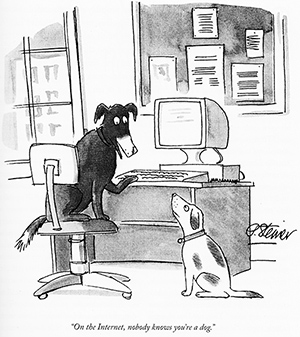
I think the statement is as true now then as it was then and it applies to both individuals and governments.  Too many people have a fantasy that they can make up online identities and interact with the outside internet.  They think they can hide behind a digital anonymity or the state’s secrecy laws and million-person security apparatus.  But, it just is not so.  You can’t hide information; you may delay its exposure but eventually information will be disclosed and used.


Peter Steiner's cartoon, as published in The New Yorker

Monday, June 10, 2013

Big Data: Government Surveillance


The big news at the end of this last week was that the US government has been collecting internet and telephone data in order to combat terrorism.  Is anyone really surprised? 
I have been involved in what can be done with big data since 1987.  I never worked with government but only commercial businesses that had large amounts of data in industries that were undergoing tremendous change.  Our biggest customers were telephone companies, large retailers, airlines, and banks.  As you may recall, the 1980’s began a period of deregulation.  AT&T agreed to be broken up into separate units in order to foster competition.   The Airline Deregulation Act of 1978 took the federal government out of setting fares and determining routes.  The financial sector saw the consolidation of banking and insurance and the repeal of Glass-Steagall.  The change in retail can be attributed to one firm: Wal-Mart dominated its category and influenced all of the industry with a big-box format, sourcing from low-cost manufacturers across the world, every day low prices and aggressive expansion.
What did all the firms in these industries do with all this data?  Typically they figured out who their customers were.  Prior to these changes either they didn’t care because they were operating in a monopoly environment and didn’t need to cater to customers.  Or, they operated at a small enough scope that the managers of the stores knew who their customers were from personal interaction.  However, once deregulation and consolidation occurred they couldn’t rely on personal knowledge; these businesses had to rely on data. 
The volume of data and the speed with which they processed it kept increasing.  They modified the capturing of the data at the customer touchpoint so that it could be collected in more detail.  They also introduced loyalty cards to induce customers to continue shopping or flying with them; but, more importantly, the loyalty cards allowed them to know when a customer came back and what they were buying; and, they got contact information for these individuals.
In other words, they could identify their customers; they knew where they lived, what their demographic are, who lived with whom.  Companies knew what they bought and when they bought it.  With telephone customers, they knew who was calling whom, how long they communicated, how often, and at what time of day these communications occurred.  The financial institutions knew your assets and how you spent your money.  The transportation firms knew where you traveled, when, and how long you stayed.
Then in the 1990’s the mobile phone became ubiquitous and the internet became consumer oriented with the changes derived from telecommunications deregulation.  We could communicate anywhere with the phone, web, email, text and tweet.  We could find out about anything from anywhere.  We could buy anything from anywhere.  The amount of data exploded and the amount of change to our lives was massive.  As Thomas Friedman stated so well in The World is Flat, the world became globalized.
The second thing these firms evolved to doing with all this data was predicting and then influencing what a customer was going to do.  They know what products and services you will likely buy.  They know when you’ll make this transaction. They predict how much bandwidth, airplane seats, teller machines, etc. will be needed.  Retailers know how much inventory they will likely need for a product that has never been sold.  On Black Friday they know within a few hours of stores opening on the East coast whether their predictions about retail customer behavior is accurate or not and then modify pricing before Denver stores even open.  They can instantaneously customize the webpage and the products offered to you based on what they know about you and your past behavior. Online advertisements are presented instantly to you because of where you’ve browsed in the past, who you’ve friended, and what you’ve liked.
Which leads me to my first question to you.  We have given very personal information about ourselves to the businesses we choose to interact with.  They know us intimately and seem to adapt to our whims instantaneously.  Now, place yourself in the federal government as someone responsible for defending us against terrorism.  Since the Oklahoma City bombing almost two decades ago, we have had a torrent of people who want to fly airplanes into iconic buildings, bomb public events and disable our digital economy.  Would you not want to use this information available about individuals to determine their nefarious whims?  Why should you be surprised that it has occurred?
When this kind of information is available and used openly in the commercial sector for twenty-six years, I can only assume that a government would use it, as well.  I admit I don’t like the thought of it with my libertarian ideal of privacy.  However, I like my frequent flyer miles and the discounts from using my loyalty card at supermarkets; I sell stuff on Craig’s List and I buy from Amazon; I use LinkedIn to market myself.  I use these things because I perceive them to be in my interest.  But, if I knowingly relinquish my privacy to an internet search engine, I am relinquishing this information to government, too. 
In some ways, its similar to the argument I made in my post on GMOs; in that case, if genetic material is made available to the environment, it will spread and you cannot predict how or where.  Genetic material is a code; it is information.  Likewise, any digital information, once disclosed on the internet, is going to spread; you cannot predict how its going to be used nor where it will be used.  Maybe it’s a law of nature that information, genetic or digital, cannot be contained.